
ERP + TMS Integration: Why Disconnected Systems Cost You Money
Discover why integrating your ERP and Transportation Management System (TMS) improves supply chain visibility, reduces manual work, lowers transportation costs, and enables smarter logistics decisions.


Many organizations invest in powerful supply chain software. They have an Enterprise Resource Planning (ERP) system managing orders and inventory. They also have a Transportation Management System (TMS) handling freight planning and carrier management. Yet despite these investments, logistics teams often find themselves copying data between systems, reconciling reports manually, and chasing shipment updates through emails and phone calls. The problem isn't the software; it's the lack of integration.
What Are ERP and TMS Systems?
An Enterprise Resource Planning (ERP) system manages core business operations such as:
- Procurement
- Inventory
- Sales orders
- Finance
- Production planning
A Transportation Management System (TMS) focuses on transportation operations, including:
- Carrier selection
- Route planning
- Freight execution
- Shipment tracking
- Freight cost management
When these systems operate independently, information becomes fragmented.
The Cost of Disconnected Systems
Without integration, businesses often experience:
- Duplicate data entry
- Delayed shipment updates
- Inaccurate inventory information
- Slow invoice reconciliation
- Limited transportation visibility
- Poor decision-making
Small inefficiencies accumulate quickly, increasing operational costs and reducing productivity.
Benefits of ERP + TMS Integration
Integrating ERP and TMS platforms creates a single flow of information across logistics operations. Key benefits include:
Improved Data Accuracy
Information is synchronized automatically, reducing manual errors.
Faster Order Fulfillment
Transportation teams receive order details immediately, accelerating shipment planning.
Better Freight Cost Control
Transportation expenses can be linked directly to purchase orders and financial records.
Enhanced Inventory Visibility
Warehouse teams know when inbound shipments are expected and can plan receiving activities more effectively.
Stronger Customer Service
Sales and customer service teams gain access to accurate shipment status information.

Best Practices for Successful Integration
To maximize the value of ERP and TMS integration:
- Standardize data across systems.
- Automate order and shipment updates.
- Integrate carrier performance reporting.
- Connect financial and freight data.
- Enable real-time shipment visibility.
How SupplySense 360 Complements ERP and TMS Platforms
While ERP and TMS systems manage business processes, organizations still need end-to-end visibility into shipment execution.
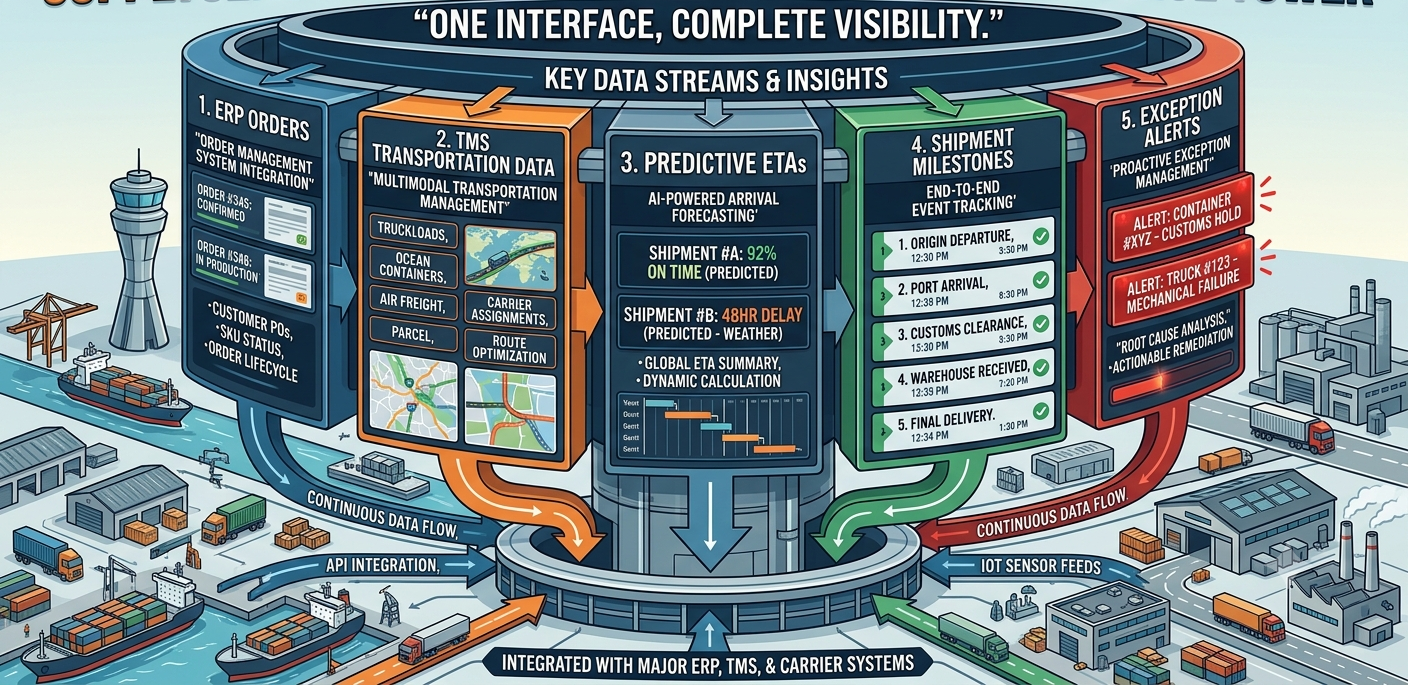 SupplySense 360 enhances existing ERP and TMS investments by providing:
- Real-time shipment tracking
- Predictive ETA updates
- Shipment milestone monitoring
- Carrier performance analytics
- Exception management
- End-to-end supply chain visibility
Instead of replacing existing systems, SupplySense 360 helps connect operational data with actionable logistics intelligence.
Conclusion
ERP and TMS platforms are most effective when they work together. Organizations that integrate these systems reduce manual work, improve decision-making, and gain the visibility needed to build more agile supply chains.